
This is a short, practical guide to the time-frame signals built into the New Testament. It does not attempt to be exhaustive. It aims to be clear.
Most modern “end times” teaching assumes the apostles were describing events thousands of years away. That assumption forces the New Testament’s time-statements to be redefined, delayed, or treated as “not for them”.
The alternative is simpler: read the text with audience relevance and prophetic idiom intact. When you do, the dominant horizon is not the end of the planet. It is the end of the old covenant world, climaxing in the judgement on Jerusalem and the temple system (AD 70), and the public unveiling of the New Covenant reality.
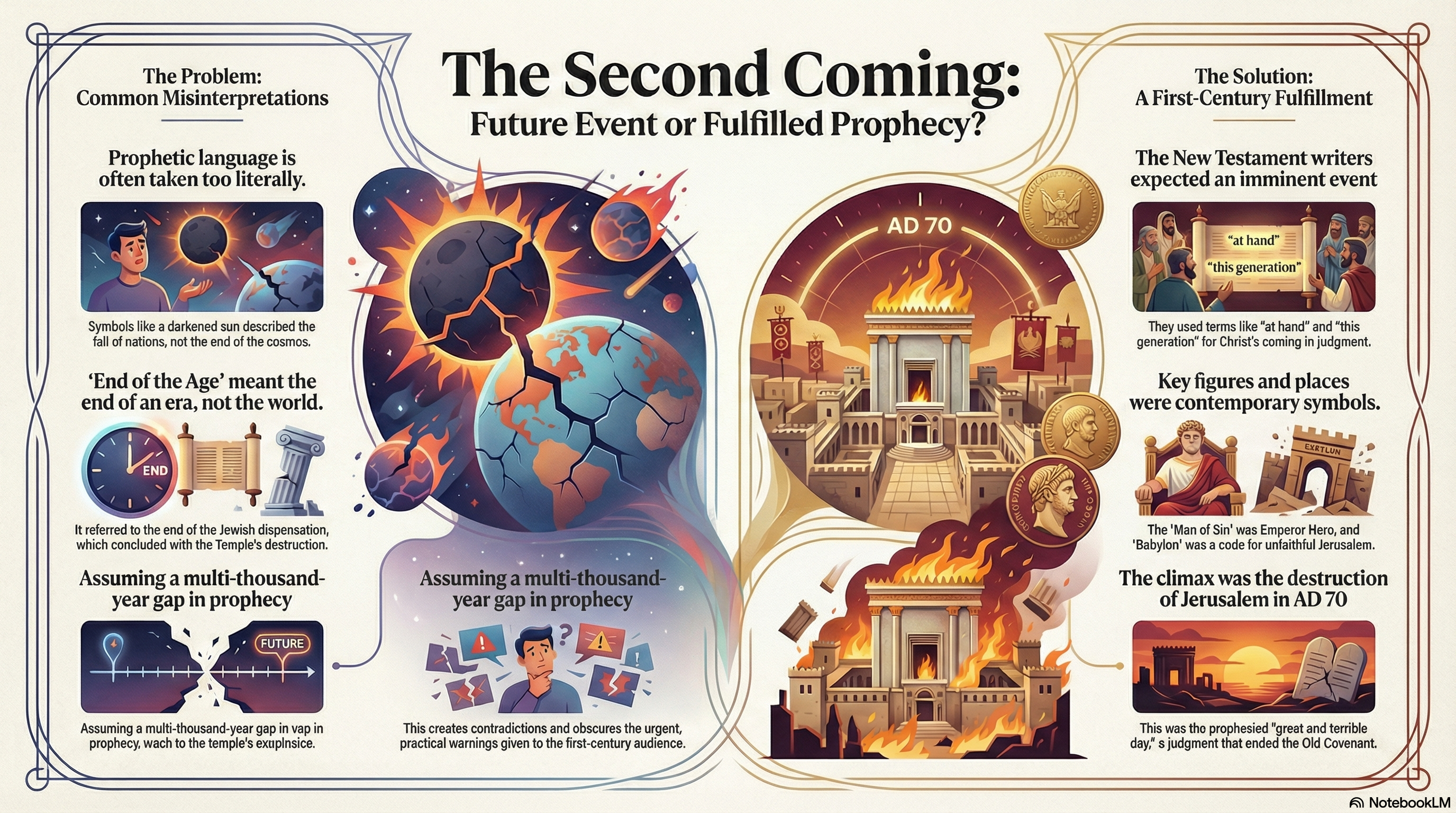
Jesus repeatedly anchored His warnings and “coming” language to the lifetime of His own hearers. He did not speak in open-ended centuries.
Original text (WEB): Matthew 16, Matthew 24
If “this generation” is pushed 2,000+ years into the future, the plain sense of Jesus’ words is replaced with a different claim. That move is the engine of delay theology.
A common confusion comes from translating the disciples’ question as “end of the world”. In the New Testament, “age” language is covenant-world language: a governed order, a religious era, a dispensation.
The disciples were asking about the completion of the Jewish age centred on temple, sacrifice, priesthood, and Law identity. The dramatic historical endpoint of that covenant order was the fall of Jerusalem and the temple (AD 70).
Original text (WEB): Matthew 24, Hebrews 8
Cosmic collapse language (sun darkened, stars falling, heavens shaken) is a well-known prophetic way of describing national judgement and regime change. It is covenant-shaking language — not a forecast of the physical universe ending.
Original text (WEB): Isaiah 13, Isaiah 34, Matthew 24
Rule: interpret prophetic imagery by the prophets first, then read the New Testament in that inherited vocabulary. If you skip the prophets, Revelation and the Olivet Discourse become a blank screen for modern fears.
The apostolic writings consistently use imminent time markers: near, at hand, shortly, about to. This is not obscure. It is everywhere.
Original text (WEB): Philippians 4, Romans 13, James 5, 1 Peter 4
Revelation begins and ends with time statements that would be meaningless if the fulfilment were thousands of years away. The book is written to real churches under real pressure, using symbolic language to reveal covenant judgement and victory.
Original text (WEB): Revelation 1, Revelation 22
If Revelation is pushed into the far future, the book loses direct relevance to its original audience. The Fulfilled Prophecy Bible treats that as a failure of interpretation: Scripture is written to people before it is applied to later readers.
These five clues form a consistent pattern: Jesus and the apostles spoke to a first-century horizon, using prophetic idiom to describe covenant judgement, transition, and the unveiling of the New Covenant world.
That does not reduce the gospel. It clarifies it. The question is no longer “when will Christ arrive?” The question becomes “will we live awake to His present reign and finished work?”
If the “coming” language belonged to the covenant transition, then faith is not built on waiting for arrival. Faith is built on living from fulfilment:
Where does my thinking still default to delay — acting as if Christ is “not yet here” — instead of living from the reality of His present reign and finished work?
Share this study: 𝕏 Twitter Facebook Email