Cisterns vs. Fountains
Why "leaking" is an Old Covenant myth and how to live in the Eighth Day Reality.
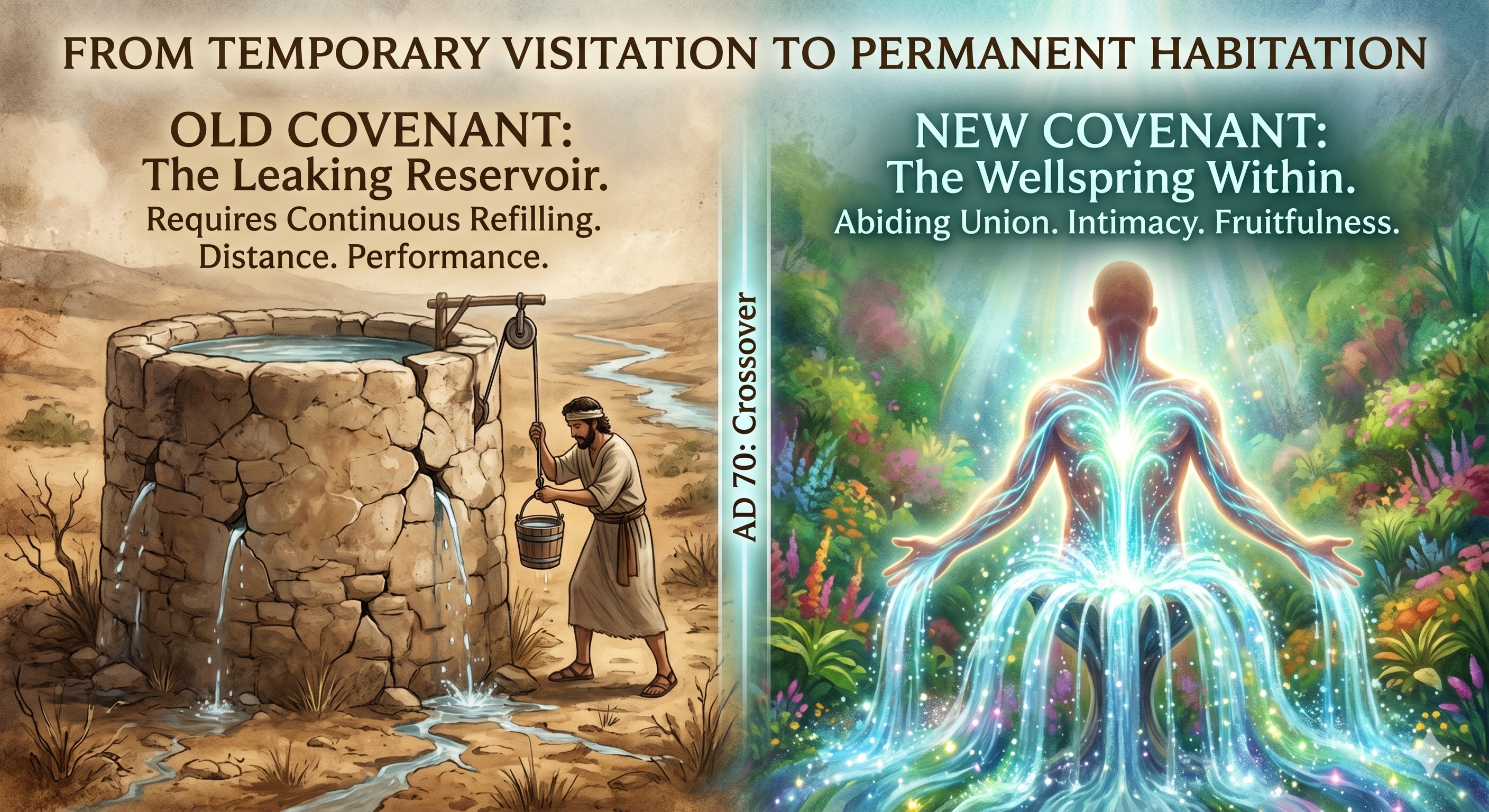
In our spiritual development, we often rely on metaphors that betray our actual standing in Christ. Perhaps none is more damaging than the idea of "leaking" the Spirit. We treat the Holy Spirit like a vessel that needs periodic refilling—a cistern that loses its contents through the daily friction of life, requiring us to perform just enough spiritual activity to top it back up.
But this "leaking" mentality is a remnant of an age that has passed. It is the language of the Old Covenant—an age of shadow, distance, and temporary visitations. To walk in the Eighth Day Reality, we must understand that the New Covenant is not a cycle of refilling; it is a permanent state of being.
The Cistern vs. The Fountain
The Old Covenant functioned on the principle of the cistern: a container designed to hold water brought in from an external source. It was prone to evaporation, cracking, and emptying. It required constant maintenance, rituals, and pilgrimages to ensure the supply remained sufficient.
Jesus dismantled this framework in his conversation with the Samaritan woman. When he offered her "living water," he defined the new reality not as a container, but as a source:
In the New Covenant, the Spirit is not something you have; it is something you are. As a son, you do not possess the life of your Father as a commodity that can be depleted; you exist in union with Him. You do not leak because you are not a container—you are a conduit.
The Performance Trap
The anxiety of "leaking" is almost always tied to the lingering psychology of the Old Covenant—a mindset that measures status through performance. When we believe that our closeness to God depends on our daily output, we inevitably live in a state of chronic spiritual insecurity. If I am "leaking," I am failing; if I am failing, I am at risk; if I am at risk, I must work harder to "get filled."
This cycle of performance is entirely alien to the Finished Work. Under the New Covenant, your "fullness" is not a gauge to be checked, but a reality to be acknowledged. You are not a container that must be filled; you are a branch that is permanently joined to the Vine. The life of the Vine is not something the branch "holds"—it is something the branch is.
The Theology of Abiding
To move beyond the myth of leakage, we must embrace the theology of abiding. Abiding is not a struggle to maintain intimacy; it is the rest of realizing that you have never been separated. In the Eighth Day Reality, the separation between God and man has been permanently removed.
If you feel "dry," you are not losing your connection to God—you are simply experiencing the inevitable exhaustion of relying on your own perception rather than the objective reality of the Spirit. The Spirit is the very atmosphere you breathe. He does not evaporate under pressure. He is the sustaining power of your existence, even in your moments of greatest weakness.
From Filling to Flowing
The Path of Sonship is not about how to keep your cup full. It is about realizing that you are the river. When you feel the weight of life, do not look for a refill. Recognize that the "Well" is still springing up within you. You haven't lost your supply; you have merely stopped flowing. We do not leak. We pour out. And because the source is infinite, the pouring never ends.
A Question for Reflection
Are you still living as a cistern waiting for a refill, or are you operating as a fountain that originates from the Eighth Day Reality? What would change if you stopped checking your "levels" and simply began to pour?
